I Need Blue
I turned around to see a masked man pointing a gun at me. It was just the beginning of a series of events, including robbery and abduction, which changed my life forever. I Need Blue, hosted by Jen Lee, is a podcast series featuring lived-experiences from survivors of life events. I NEED BLUE creates space for survivors of trauma to feel they BELONG, are LOVED, UNDERSTOOD and EMPOWERED! I called 9-1-1 and they provided me with life-saving directions to help my customer who was having a medical emergency. Law enforcement rescued us and caught the robber. Our first-responders face unique traumas every day. I NEED BLUE provides space for them too!
I Need Blue
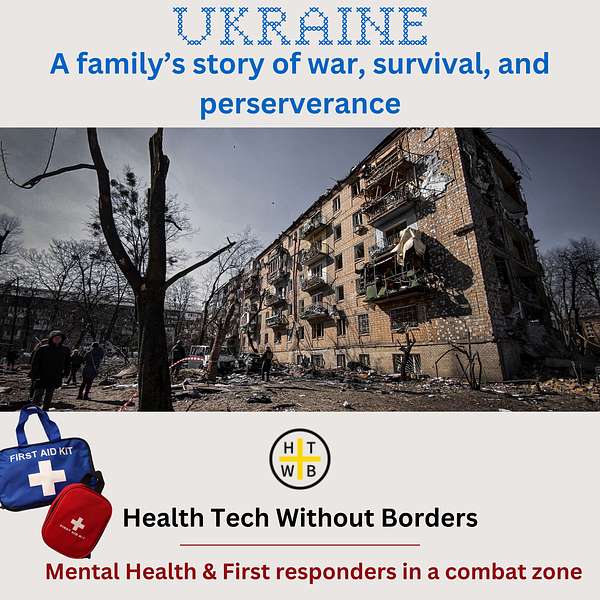
Olga: A Ukrainian Families Journey of Resilience Amidst War
As the first light of February 24, 2023, painted the horizon, Olga's world was abruptly shattered by the haunting echo of her father's words: "the war has started." Feel the weight of her heavy heart as she, a compassionate nurse with Health Tech Without Borders, recounts the visceral emotions that gripped her en route to the airport, learning of the invasion that would change her life forever.
Amidst the chaos, Olga reveals the challenges of survival and the role of digital health innovations, such as tactical medical chatbots developed in partnership with Microsoft. Her story sheds light on the importance of technology in Ukraine's medical response and how it has become a lifeline amidst trauma. This episode explores the resilience of the human spirit, the hope found in family bonds, and the power of innovative solutions during times of crisis.
To learn more about Health Tech Without Borders: https://www.htwb.org/
Connect with Jen:
I Need Blue now has a new home at The Healing in Sharing! Visit thehealinginsharing.com to explore Round Chair Conversations, all relevant I Need Blue content, and ways to support the mission of sharing stories that inspire hope and resilience.
By sharing the hidden lines of our stories, we remind each other we are not alone — together, we step out of hiding and into healing.
Instagram: @ineedbluepodcast
YouTube: https://www.youtube.com/@ineedblue
Apple Podcasts: Listen & Subscribe
YouTube: https://www.youtube.com/@TheHealingInSharing11
Memoir: Why I Survived, by Jennifer Lee on Amazon
The background music is written, performed and produced exclusively by Char Good.
https://chargood.com/home
Everyone has a story. They just don't always have a place to share it. Music.
Speaker 2:Welcome to the I Need Blue podcast. This is Shar Good and I am honored to introduce Jennifer Lee, author, life coach and host of today's show on the I Need Blue podcast MUSIC.
Speaker 1:Thank you for that warm introduction, shar, and welcome to I Need Blue, the podcast about to take you on an extraordinary journey where profound narratives come to life, one captivating episode at a time. I'm your host, jennifer Lee, and I founded this podcast because I know there is healing and sharing. Each story you will hear shared on this podcast is a testament to our collective strength, innate ability to transform in the incredible power of healing. Please remember you are never alone. Please visit and share my website with those seeking connection and inspiration wwwineedbluenet. Thank you, shar Good, for composing and performing the introduction medley for I Need Blue. You can find information about Shar on her website, wwwshargoodcom.
Speaker 1:Before starting today's episode, I must provide a trigger warning. I need Blue features graphic themes, including, but not limited to, violence, abuse and murder, and may not be suitable for all listeners. Please take care of yourself and don't hesitate to ask for help if you need it. It's time. I have the honor of introducing my next guest, olga. The CEO, jerome Lee of HealthTech Without Borders, htwb, connected us.
Speaker 1:I wanted to put a spotlight on the trauma experienced from witnessing a war zone. That is what we will talk about today in how HTWB is helping our first responders in Ukraine. Olga was born in Kiev and now resides in the Netherlands. Her parents still live in Kiev and witnessed their home destroyed on February 24, 2023, as Ukraine was being invaded. As you can imagine, olga sometimes could not contact her parents. Losing their home and losing touch with their daughter left her parents traumatized Shortly after they reconnected and managed to escape the war zone.
Speaker 1:Since the beginning of the war, olga has visited Kiev twice to see her parents, who decided to move back to the only country, the only home they knew. The devastation Olga witnessed was heartbreaking. She will share her findings with us today. Olga has a nursing background and is involved with HealthTech Without Borders. Htwb invests its time focusing on the mental health of first responders attending to those in Ukraine. They invest in education and offer several programs that focus on how to help the helper heal. It's pretty impressive and I'm excited for Olga to share more details with us. So, without further ado, I extend my heartfelt gratitude to Olga for being my special guest on the I Need Blue podcast.
Speaker 2:Thank you so much, jennifer. It's my great pleasure to be here and to speak to you about my experience, and I am happy to share my knowledge and my understanding about what the situation is, about the current states, but also the programs that we're having within HealthTech Without Borders.
Speaker 1:So thank you, you're so welcome. I'm really glad we connected and I'm really excited you accepted my invitation to come and speak with me today. Now you are in the Netherlands, I'm in Florida, so tell me a little bit about what the weather is like today in the Netherlands. I'm curious.
Speaker 2:Well, I believe it's way colder than in Florida right now. So it's raining today, so it feels like a real autumn, and it's quite dark as well, as we have several hours time difference, so it's quite cold, I would say.
Speaker 1:Yes, anything below 70 is cold to me.
Speaker 2:Okay, in Fahrenheit, right, because I'm used to working Celsius.
Speaker 1:So, yes, that is, 70 is high and I like to have humidity as well. I found that's. What keeps me warm is the humidity. Anyway, thank you for sharing that with me. I'd like to jump right in and ask you to share the moment you heard about the invasion in Ukraine, in the country where you grew up.
Speaker 2:Yes, yes, I do remember this day and this morning very well. At that day, 24th of February, I was heading to the airport because I have a meeting in India and I was sitting in the train and it was quite early I think it was 6 am in the morning. I was checking my phone and I saw that my father had been seen. I mean, I appreciate that so much that digital, the social media, has this function lost scene, because I will tell you later this, especially this message, meant a lot to me, to my sister and, I think, to many people, those days when you can at least track what was the last time the person was seen online. So of course, we knew that something good happened. Obviously, I could not think that the war would really happen. So I've seen my father, last seen online like one minute ago. So I thought, well, that's if he's not sleeping and he's an early bird. And they just called him. He picked up the phone and he said well, the war has started.
Speaker 2:And I remember it was a really chilly feeling that I had. I say I was sitting in the train, having the bag with me, the trolley, happy to go to another continent, because I was looking forward to this trip. And there it was. The war has started, my parents are in the middle of there and I'm going to another continent. It was awful. It was awful feeling and, frankly, I didn't know what to say, what to do. Did I go back home and drive to Ukraine, because probably all the airports were closed at that time? I didn't know what to do. That was awful uncertainty, I would say.
Speaker 1:For sure, and I can't imagine your dad Was he like I don't know what to do? What were they told to do at that time?
Speaker 2:They didn't have any information at that time, as far as I know. As I remember, they were told on the radio and the media that the war has started. You know, ukraine is a highly digital country. We can get the resource and the information from anywhere online. So there was lots and tons of information available online and obviously everybody was scrolling through this information. Of course there was some information on the radio, on the national television.
Speaker 2:Of course people were trying to comfort the population, even though the war has started. They tried to comfort them and ask them not to, you know, not to make a sudden move or not to move immediately, because that could be still potentially dangerous for them as well. As I remember, they didn't receive any guidance the first hours. I don't think it were possible. Of course, it was heartbreaking to see that and to hear that, and I remember he said that, well, mom is still sleeping. So I don't know whether I should wake her up. And you know, with this news, you know what to do because, well, my mom can get a little bit grumpy if she would be waking up too early. I mean, what would you do in these circumstances?
Speaker 1:I don't know what I would do. I hope that I am never in that situation.
Speaker 2:I hope so too, yes.
Speaker 1:When was the last time you were able to talk to your dad? Because, within the war zone, obviously, things were being destroyed. Being able to use our technology to communicate was shut off.
Speaker 2:Yes, especially in February, the end of the February, beginning of the March. That's when at least my family were impacted by the war. The funny thing is that everybody using well Internet, of course mobile data and unfortunately it seems like the Internet connection in the private area, where only two storage houses there, there could be some difficulties. If you're not high enough, let's just say so your router would not reach out to the signal. And that's actually what happened to my parents, because they're living in a bungalow house and they were just not high enough to reach out to the signal. So everything they didn't have connection at that time and that's when me and my sister had most of the problems to reach out to them.
Speaker 2:Because I tried several times to reach out to the volunteers who were active at that area just to go and check on my parents. But they say, yeah, just send them a link to where together. And I was shocked because I couldn't send any link. Even the SMS were not going through. We're not even using this type of messaging anymore. So in the beginning, in February, late February, in the beginning of the March, we had major problems with the connection.
Speaker 2:Yes, so, from the beginning of the war to when it had finally then reached where your parents live and they lost their home, how long had the war been going on before it directly impacted your parents, I think one or two weeks, because the area where they live it was really a dangerous area because the invaders were actually there, like physically present in there, and that's why it was awful, especially because we knew that something awful was happening in that area and they didn't, because they were cut off of that information and the neighbors were not there as well, because they fled earlier. I think it's about two weeks, and after two weeks they have been evacuated and they went to Netherlands. At the time when they were at my place in the Netherlands, the house has been hit again. Well, basically, when they left the place it was still quite okay, but when they got back in May last year they saw the destruction.
Speaker 1:Yes, looking back now, is there a oh my gosh. My parents are lucky to be alive. Yes, absolutely.
Speaker 2:The buildings, the houses, the streets, infrastructure. It's awful when it's damaged, but it's nothing to compare with the human life. So, basically, when we're looking back and, honestly, the war is not yet over. My parents are, of course, repairing the house, but still we're so lucky. Obviously would you hope that that would be the last time it would be restored.
Speaker 1:And then did you go back. When your parents decided to go back, did you make that trip with them? No, I didn't.
Speaker 2:So they went on their own and we were constantly in touch with them. But I do regret that I wasn't able to go with them at that time. But I think what they saw, I can't imagine the feeling, especially of my mother, because that's the house where she was born, that's real her place. So I think for her it was absolutely painful just to go there to see those windows, to see that roof, to see those walls. But again, jennifer, it's just the building, that's the thing. It's traumatizing, but I think it's less traumatizing when you can compare it to human loss.
Speaker 1:Yes, when your parents went back, did they have to experience that human loss of a neighbor or someone nearby, someone they were close to?
Speaker 2:Yes, maybe not direct relatives, because we do have a very small family. My mother she's the only child. Her parents are not with us anymore. It's quite an awful thing to say, but her mother died 10 days before the war started. It's awful, but we were so lucky that she made it to be buried on time properly buried, because after the horrible events it was quite difficult to bury people because that was not a priority anymore. My mother she's still saying that she's grateful that her mother passed away on time without seeing the war again, because she was already a war child.
Speaker 1:That would have just been horrific for her. So it's sometimes out of tragedy we can look back and now realize that that actually was a blessing. Yes, exactly.
Speaker 2:Exactly Some of my neighbors, yes, unfortunately, but nobody from my family, luckily. So I'm blessed that it didn't happen to my family. But of course, many people that they knew were hit by the war either lost their loved ones or they were heavily hit by the war itself.
Speaker 1:How do they deal with the fear? There's got to be fear that they could relive this all over again.
Speaker 2:I don't know, and that's the thing I'm still trying to discover. I'm still trying to because we talk to my parents daily. I'm still trying to understand. How are they coping with that, day in, day out, although I have been visiting them for, let's just say, in total four weeks I was in Ukraine in the period of the past two years but still I don't understand how do they cope with that.
Speaker 2:So there is a coping mechanism that they have discovered or they have created, which is, I have to say, very different. My mother and my father's coping mechanism are not comparable. I see them doing that, coping with the tragedy in their own way. So for me, for my mother at least, I know that she is really, she belonged there. So that's her lens, I mean even the house and the property. For her, it's a temple. This is how I would describe it. For my father, he is just really a carpenter, a handyman, not by the profession, by just a great hobby of his. So he is coping with that by actually doing stuff, by rebuilding, by decorating, by creating something new, and, yeah, this is how they find it, I guess, and they are happy to be there and to be able to contribute in a way.
Speaker 1:When they first got home, did they send you pictures?
Speaker 2:Yes, I do have those pictures, wow, I can share that with you as well.
Speaker 1:Yeah, because I probably I have no comprehension of what they went home to. I have none, as I'm sure you were probably just as shocked. Wow, this is what it looks like.
Speaker 2:Yes, the awful part, that the part which was hit the most, it was the part of the house where my mother used to make clothes, because she has several machines there to upcycle this stuff and this area was totally destroyed. So and I can imagine if she was there at home it would be the end Right. Looking back and seeing those pictures, you know, I just saw the money can that I brought her last time and it was just there, the parts. You know there was the money can that she put all the stuff she's designing.
Speaker 1:So for me it was just incredible picture of something, of this strategy in a way, something you know so fragile yes, you know we have talked a little bit about coping, a little bit about loss and that kind of segues us into. You have a nursing background and you know work for health tech without borders, helping to help the first responders. So my first question for you is the first time you went back to Ukraine to visit your parents as a as a first responder, with that nursing background, what was it like for you it?
Speaker 2:was a very unique feeling because whatever I learned before was, in a way, hardly applicable to the war zone, because those skills that we learn at school, at the college, at the university, are normally Not based on the disaster. So this disaster response and disaster management skills Seem like do not have them in the beginning, because why would you? You are not prepared to that whatever. I seen her from the colleagues there, from my ex classmates. It was a very unique feeling of how people were coping with the war, how they were well trained and how strong they were. This is, this is the feeling that I immediately sensed, because I was expecting people in total chaos, but the people who state, the healthcare professionals or any other people who thought that their contribution would be available for the society, for the population, they showed amazing subset of skills which were really great.
Speaker 1:Yeah, great, sometimes we have abilities that we don't really realize until we're forced into a situation where we have to think differently, we have to react differently. You just kind of figure it out, don't you?
Speaker 2:Yes, exactly, exactly. And also quite important to notice is that, as I already told you, ukrainian population are really highly digital population, so introducing the digital health or tools or technology was quite surprisingly easy, because you know, you can imagine when the healthcare infrastructure is destroyed and you still need to see a clinician in any way, whether it's a chronic or acute disease, you need to have the opportunity or the alternative to see them. You know the clinician, so that was quite amazing to see how healthcare professionals were dealing with this new piece of technology that they were not using on professional level that much.
Speaker 1:I'd like to create a visual after what you just said. Here is what I'm saying. Hospitals have been bombed, medical facilities no longer exist, so y'all had to come up with a way of how do we provide the medical care that these people need without having that brick and mortar building for them to go to.
Speaker 2:Yes, exactly, that's basically what's what happens, because obviously you would need to have internet to provide any any kind of digital health interventions. So if you have the internet connection, lots of possibilities arise, which is actually great because there were so many people, and we're so grateful for all those clinicians, supporters, volunteers, who just volunteer their time and their expertise. Using even simple Google Translate would help a lot, and one of our partners, the company Dr Online, did provide the digital health consultations and there was the possibility to translate their message. So it was either synchronous or asynchronous support, but it was all possible. So it was. It was amazing result how this humanitarian disaster could still be supported by by means of the digital health intervention from from many, many colleagues and clinicians overall in the world.
Speaker 1:So when you first went back to Ukraine, what was the immediate need?
Speaker 2:I would say it was still mental health. So those are, you know, unseen traumas, those cars that's that are still. It's quite scary to imagine what it would be. I'm not even talking about the PTSD, I'm just, you know, I'm just scratching the surface and just talking about the low moods or the depression. You know the anxiety that lots of people has developed already. So I would say that, for me especially, I'm thinking that we should be investing more for into, especially, mental health support. It is possible to invest more, but we still need to resources obviously to do that.
Speaker 2:There is a lot of stigma around mental health. So how do you, how would you break it? You know, many people would say well, as long as I'm alive, as long as my family is OK, as long as my son is still all right and he's serving on the frontline, all is fine. You know I don't need support, but obviously we know that that's not true. Those hidden scars are, you know, masked under some kind of I don't know the feeling of, sometimes maybe even feeling of guilt survival skills could be. So, yes, I would say I'm strongly insisting that mental health should be, and still is, the area that's have to receive way more support.
Speaker 1:Yes, and are you finding when you are working there that the first responders are open about their mental health needs? Or is the stigma kind of creating that quietness of I'm the helper? I don't want to be the help.
Speaker 2:Yes, Well, it's getting better, which is which is actually great. I have to say that in Ukraine, we do have a lot of mental health practitioners. It was highly popular to be a psychologist back in the normal days, obviously, and of course, now, when we are dealing with the war trauma, not many psychologists are prepared for that. Also, as you know, jennifer, the war in Ukraine has actually started in 2014. So there are already experts who are working in the field with war trauma. However, of course, there is a huge scarcity in those resources as well.
Speaker 2:So our primary idea would be to support those healthcare providers, mental healthcare providers who are providing the mental health support to the population. I would say that their mental health providers are open to that. Regarding the clinicians, who are not necessarily working mental health fields, I think it was more challenging to get them so far to you know, just to address their needs. So we do not particularly call it as mental health. You know, treatment. It's just a support. It just appears support so you can talk to someone who understands. You do not need to counsel anyone, so it's just an open conversation. So we do not want to treat those clinicians as patients because they're not.
Speaker 1:So, yeah, it's really providing that ear to listen and have support. Yes, I love that. Let's dig into a little bit more about health tech without borders. H, t, w, b yes it would be amazing.
Speaker 2:I would share the details, of course. So health tech without borders is a global and nonprofit organization, and we're trying to support people experiencing healthcare crisis by investing or leveraging the digital tools and technology.
Speaker 1:Wonderful, and you have different programs. Yes, so we do have several programs.
Speaker 2:One of them is, of course, on mental health and the disaster that's associated with psychological trauma. Then we another project that's also easily found to be found on the our website was the Pakistan flu response, the flood in Pakistan that that has been, you know, in June 2022. We also had the program on that. Then there is an amazing project which is actually tactical medical chatbot that we have delivered. We worked on that together with Microsoft disaster response team. Through these chatbots, people civilians, but also also professionals would be able to see the protocols based on the stop the bleeds program, care on the fire, tactical combat, causality care so those would be more appropriate for the front, for the frontline first responders. We are actually using it to support our healthcare professionals, students, so the young healthcare professionals, just to train them, just to go through the chatbot, to train their skills when it comes to, you know, to care on the fire or stop the bleeds.
Speaker 2:We are not limited to one country. For example, right now there is also one project towards the African support, so it's called Vital Africa. Yeah, we definitely thinking and expanding our focus and we're active in several countries. As I already told you was also Pakistan. There are possibilities to expand our knowledge even further than that. I would also share the information with you Probably it could be edits, as I don't know, as some kind of description where we're active, and obviously lots of information can be found online Right now. We would like to expand our activities even further than that because we're global NGO, so we're not limited to Ukraine whatsoever.
Speaker 1:Awesome. Before we end the interview today, what are some words of hope that you have for people like your parents who are living in an active war zone, and for the first responders who are helping?
Speaker 2:Well, I would say that's a tough question. You know, be mindful about your surrounding. In a way, that's the appreciation of small things around you, like. I love this example, like a smell of a fresh coffee, for example, every morning. Or just going outside, having, you know, feeling this breeze on your face or in your hair, just walking with your dog, be able to watch the movie and just have fun, you know, because I think personally that the strength can be seen in people who are really enjoying life instead of people who are struggling every day and not finding any comfort in good things as well, because it's a ray of light to me just having fun, just enjoying being together with your family members. So, for example, my parents are appreciating every morning coffee with me, me and my sister. So we're there on WhatsApp having coffee all together, and sometimes there are also my sister, children and my dog is next to me and my parents' dog, the small dog, is there. So we're kind of united and that's a great moment.
Speaker 1:I love that and I love that you said united so important. We could do another whole episode on the importance of being united. Olga, I am going to thank you for being my guest on the I Need Lou podcast.
Speaker 2:Thank you so much, jennifer. It's been amazing. You know your podcast and the work you're doing is truly inspiring, so I am grateful for being invited and, obviously, to get to know you, jennifer.
Speaker 1:Absolutely, and we'll continue to communicate on WhatsApp. Again, technology is amazing and it brings people together, so thank you again, olga. Thank you so much.
